The uncomfortable history of a public law and a closed tourism model.
The scene that keeps repeating
A Dominican musician sets up a chair on the sand in Juan Dolio on Father's Day weekend. Hotel security approaches. He's told he can't sit there; that stretch is for members of the club next door. He films it. The video spreads.
Four days later, the Ministry of Tourism announces an inter-institutional working group with the Ministry of Environment, the Ministry of Interior and Police, and the Attorney General's Office, created specifically to clarify the rules on coastal access.
The next day, a well-known Dominican broadcaster is on Macao Beach in Punta Cana. According to the complaint he later filed, staff asked him to move his umbrella (first toward the edge, then further down) to clear space for a private wedding and photo shoot. He moved. Then he filed a formal complaint anyway, arguing that he had been standing on public ground the whole time.
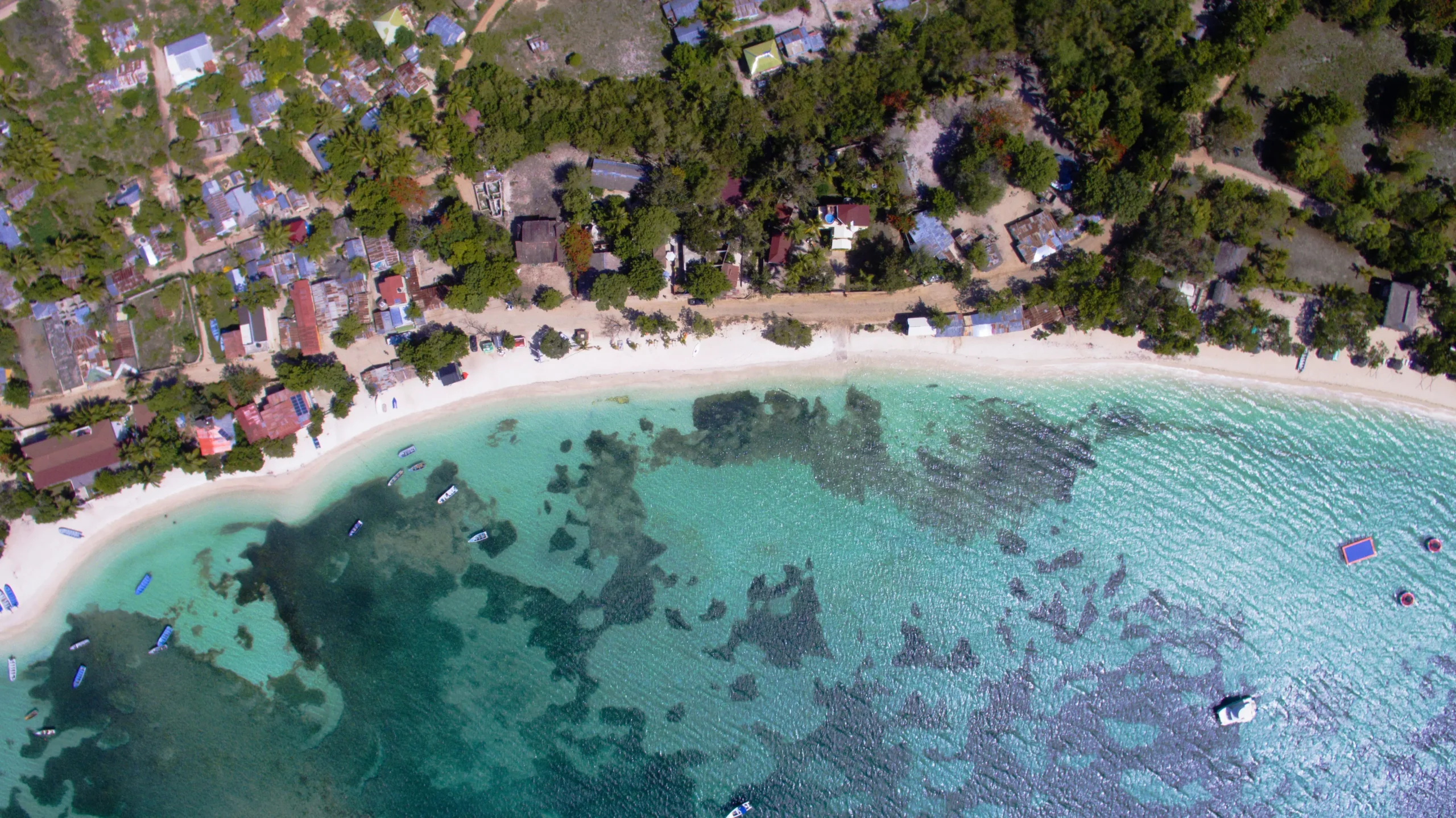
Punta Rucia, on the Dominican Republic's north coast near Puerto Plata.
One incident. An official response. Another incident the following day.
Here's the uncomfortable part. Neither of these cases involves a legal grey area. Dominican law on this question is unusually clear, and has been since 1968.
So the question isn't are the beaches public. They are. The question is harder:
If the law says every beach in this country belongs to everyone, why do so many of them feel like they don't?
That answer isn't in the law. It's in what got built on top of it.
First, a number that should surprise you
Before assuming this is a Dominican failure, look at where the country actually sits on the world map of coastal protection.
California protects to the mean high tide line.The 1976 Coastal Act guarantees public access to the wet sand and blocks developers from closing traditional paths to the shore, but the dry sand above that line can be privately owned.
Spain protects the most.The 1988 Ley de Costas made the shoreline irrevocably public and layered a 100-meter protection zone and a 500-meter influence zone on top of it.
The Dominican Republic protects 60 meters, and has since 1968, twenty years before Spain's law and eight before California's.
Notice what that does to the story. The Dominican rule isn't weak. Measured against Mexico, the country that runs the Caribbean's other great all-inclusive corridor, it's three times more generous, and it's two decades older than the European benchmark.
So if the law is strong and old, and the problem persists anyway, the problem was never the law.
Same script. Different country, different legal system, different income level. A strong law, a resort corridor, and a shoreline that quietly stops feeling public.
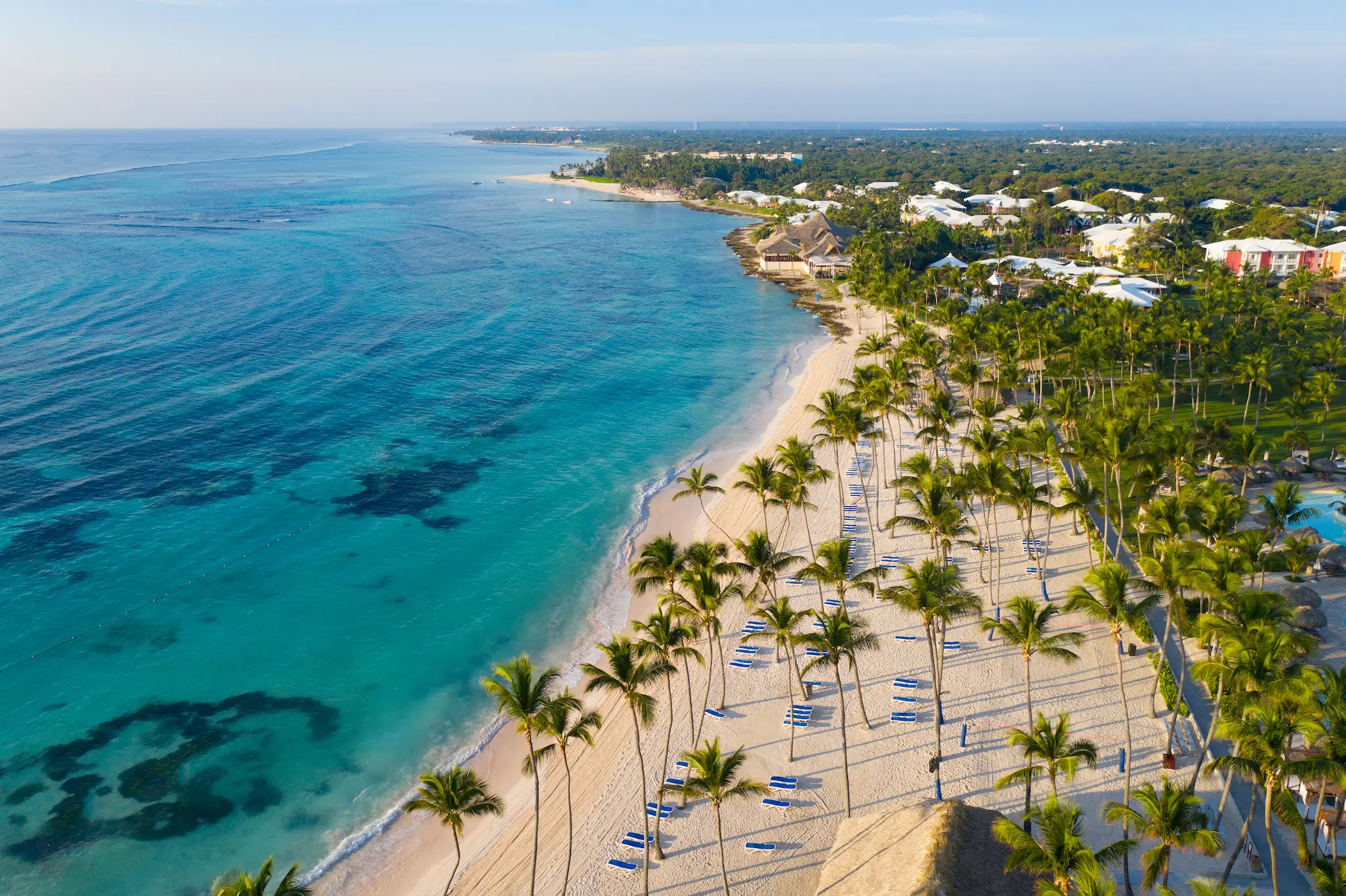
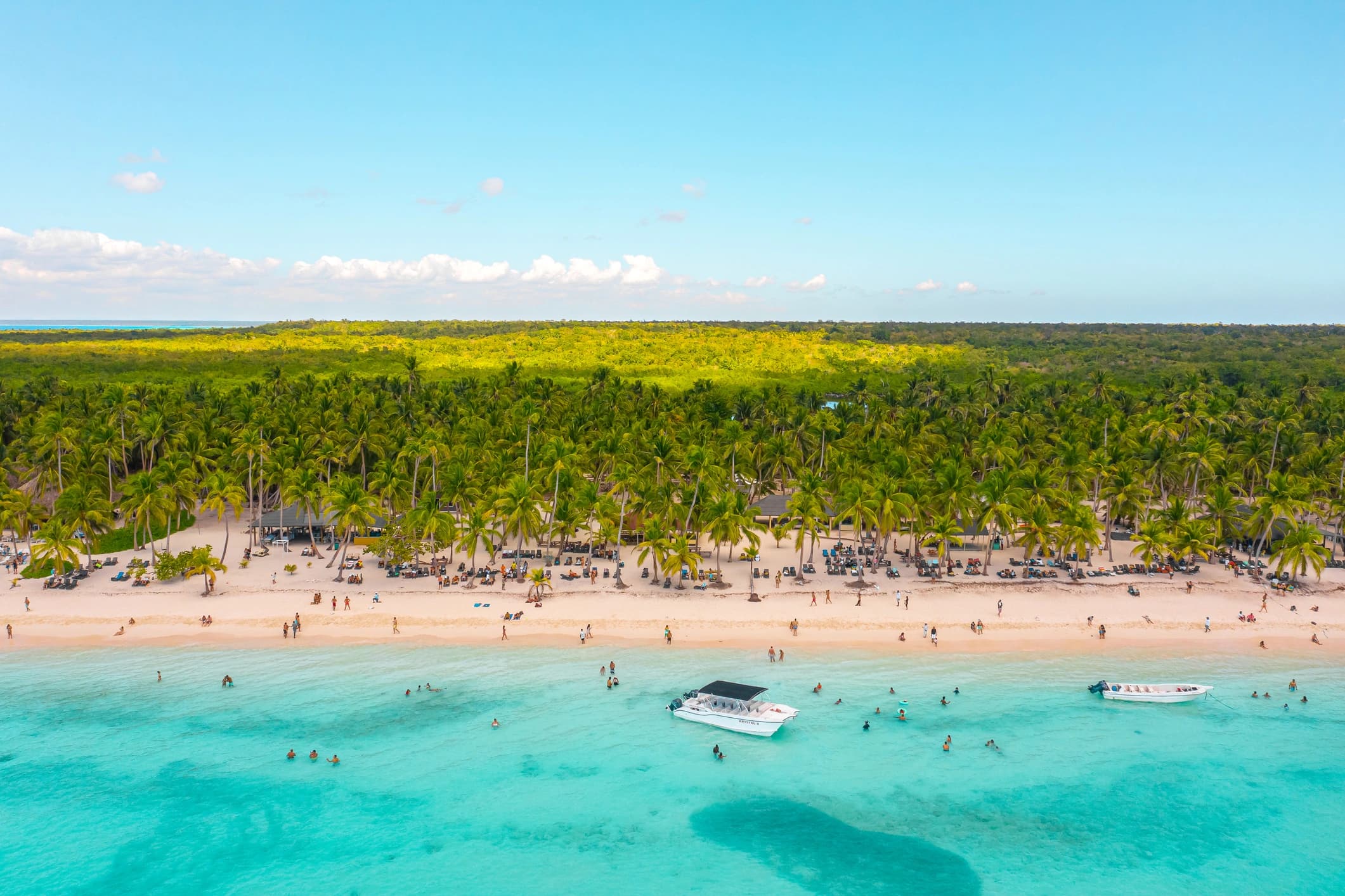
The resort corridor in Punta Cana. Under Dominican law, the 60 meters of sand nearest the water is public everywhere along this coast.
That's your first clue that we're not looking at a Dominican problem. We're looking at what happens anywhere the all-inclusive model meets a coastline, and the Dominican Republic just happens to have the receipts on video this month.
What the law actually says
The Dominican Constitution, in Article 15, establishes that rivers, lakes, lagoons, beaches, and national coastlines belong to the public domain and are freely accessible, while respecting adjacent private property rights.
That principle has a specific number attached to it. Law 305, passed in May 1968, created a 60-meter strip measured inland from the high-tide line, along every coast in the country. Inside that strip, construction is prohibited as a general rule, with exceptions the Executive Branch can authorize for tourism or public-utility projects.
The General Environmental Law 64-00 reinforces it. Articles 145 through 147 classify these coastal areas as public maritime-terrestrial domain and define them as inalienable, imprescriptible, and unseizable: legal language meaning they cannot be sold, cannot be claimed through long-term use, and cannot be seized as collateral. No one owns them. Not a developer, not a hotel, not a homeowners' association.
And in December 2023, the Constitutional Court settled the practical question in ruling TC/0751/23: owners of property adjacent to the coast cannot obstruct access to beaches, coastlines, and riverbanks. Owning the land behind the beach does not grant authority over the beach.
The simplest way to hold all of this in your head is to stop thinking of the beach as land and start thinking of it as a street.
You can own a building on a street. You can own the best building on the street. What you cannot do is decide who walks past it. The pavement was never included in the purchase, and no amount of money changes that, because the thing that makes a street a street is precisely that it belongs to no one in particular.
The 60 meters work the same way. It's a public street made of sand. Keep that image; we'll come back to it.
Where the 60 meters came from
The number wasn't arbitrary, and it wasn't always 60.
Picture the Dominican coastline in 1968. There is no Punta Cana. There is no Bávaro. The international airport that now moves millions of visitors a year won't exist for more than a decade. The country is three years out of a civil war and a foreign military intervention, and tourism is not yet an industry, it's an idea some people have about the future.
The shoreline in that moment is mostly fishing villages, sugar country, and empty sand.
And the law on the books protects 20 meters. That's it. Twenty meters is close enough to the water that permanent construction can sit almost on the beach itself. It was written for a country nobody was rushing to build on.
Think about the timing for a second. Nobody was fighting over that sand yet. There was no hotel lobby to resist, no beachfront boom to slow down, no viral video forcing anyone's hand. Somebody widened the protection before there was anything to protect it from.
The stated reasoning was to preserve the beauty of the natural landscape as a tourist attraction, and later, after the 2000 environmental law, that same strip was understood as protection for coastal biodiversity too. A wider band absorbs storm surge, holds dunes in place, and slows erosion. It also keeps the view.
Read it in context and the 1968 law looks less like regulation and more like a bet: that an open, protected shoreline would be worth more to this country over the long run than whatever could be built on top of it.
Here's the part worth sitting with. That bet was placed before the all-inclusive resort existed as we know it. Every hotel you can name in Bávaro, Punta Cana, Juan Dolio, or Puerto Plata was built on a coast where the rule was already there, already public, already 60 meters.
Nobody bought into an ambiguous coastline. The terms were set in 1968.
So where does it break down?
If the law is strong, old, and clear, the friction has to be somewhere else. It is. It's in the space between the statute and the daily habit, and it shows up in three places.
The exception clause. The 1968 law prohibits construction in the 60-meter strip except where the Executive authorizes it for tourism or public utility. That exception exists for legitimate reasons. But exceptions granted decades ago, in documents that aren't always easy for a citizen to locate, accumulate into a coastline where nobody on the ground is quite sure what was permitted and what wasn't.
The workaround, not the confrontation. This is the detail that reveals the real pattern. Alongside his Juan Dolio complaint, the musician described a practice he says he's encountered on other tourist coasts, including Dominicus: stretches of beach closed off on the grounds that they're reserved as a "boat passage." As Dominican outlet El Inmobiliario observed, that suggests the problem isn't isolated security guards improvising, it's mechanisms designed to work around the rule without openly breaking it. A gate needs a justification. "Boat passage" is a justification.
The inherited assumption. If your business model sells exclusivity, it's a short mental step from we manage this resort to we manage this beach. No one has to decide to break the law. The beach just quietly gets filed under amenities.
None of this requires bad faith. It requires only that nobody corrects the assumption. Which is precisely what viral video has started doing.
What's happening right now
Both 2026 cases are unresolved, and it's worth being precise about that.
In the Juan Dolio case, Tourism Minister David Collado publicly disavowed any attempt by private security to restrict beach access, saying the incident was an embarrassment and that the beaches belong to the people. He announced the inter-institutional working group described above.
In the Macao case, the complaint was filed with the Ministry of Environment and copied to the Ministry of Tourism, the Higüey City Council, and CESTUR (the specialized tourist security corps). It cites Article 15 of the Constitution, Law 305-68, Law 64-00, ruling TC/0751/23, and Environment Ministry Resolution 026/2025. It asks for an investigation, an end to the practice, periodic inspections of that stretch of beach, and sanctions if irregularities are confirmed.
As of publication, the resort named in that complaint had not issued a public response, and the Ministry of Environment had not announced the opening or the results of an investigation. No authority has ruled on the case. What exists is an allegation, a documented video, a formal filing, and a government working group, which is a real development, not a verdict.
What this means for you as a traveler
So you're on a Dominican beach next month and someone in a uniform walks toward you. What do you actually know?
Five things:
The sand in front of your resort is public. The 60-meter strip from the high-tide line is public domain. A hotel can control access to its own property (pools, loungers, bars, restaurants, the building itself), but the beach is not its property.
Hotel loungers are a different question. This is where most confusion starts, and it's fair. Chairs, umbrellas, and service that belong to a hotel are hotel property, and being on a public beach doesn't entitle you to use them. Bring your own. The distinction is your presence on the sand (protected) versus their equipment (not yours).
You can enter from a public access point. Beaches must have public entry. If a road toward the water dead-ends at a gate, that's worth questioning, and worth documenting.
If you're asked to move, you have options. Both men in these cases stayed calm, and one of them complied and then filed a complaint. That order matters. De-escalate on the sand; escalate on paper. Photos, video, location, date, and time are what make a complaint actionable. Complaints go to the Ministry of Environment, with copies to the Ministry of Tourism and CESTUR.
Respect what's genuinely private. The Constitution protects public access and adjacent private property. The argument for public beaches is strongest when the people making it aren't overreaching.
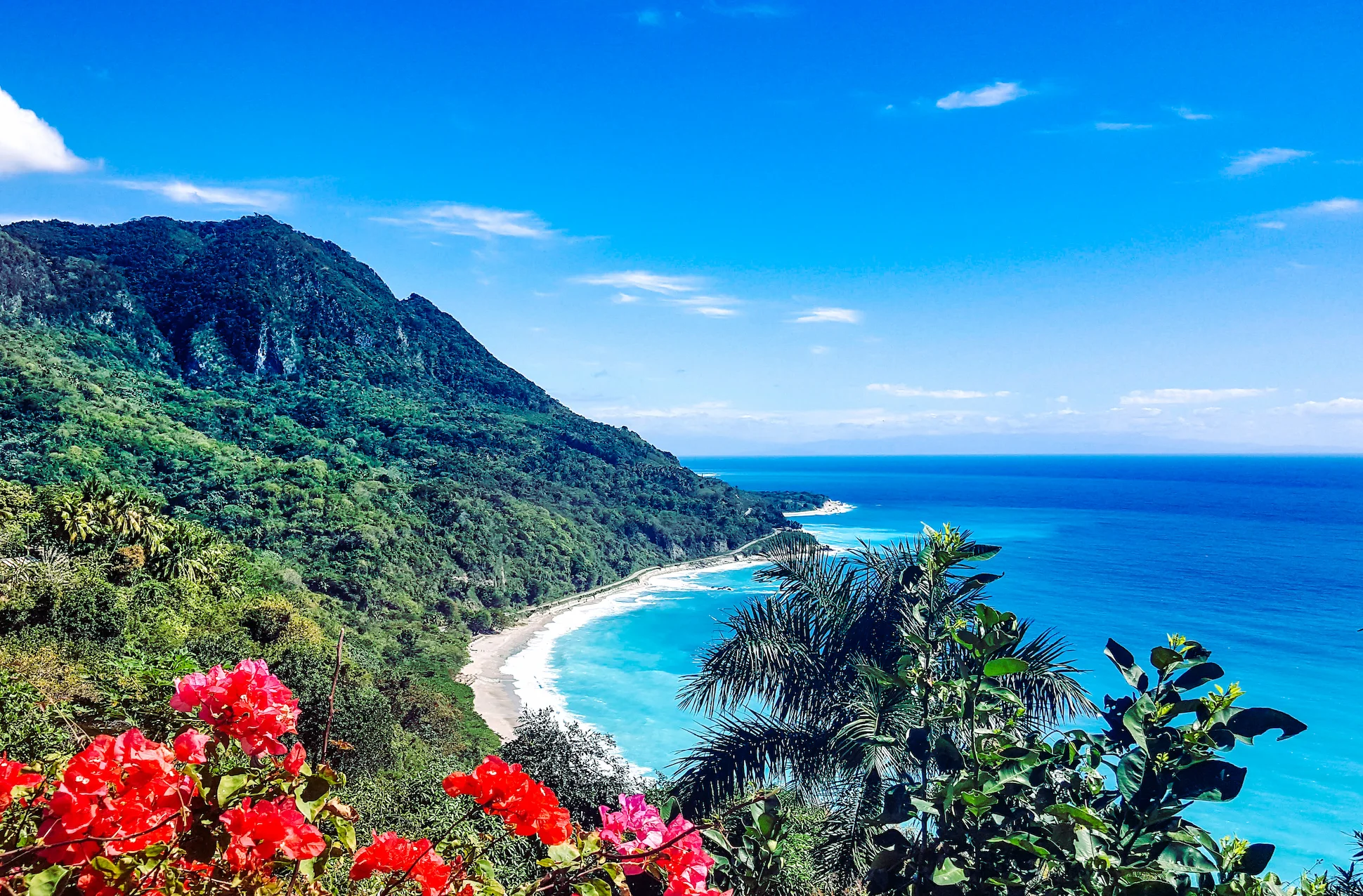
Playa San Rafael in Barahona, on the southwest coast. Every stretch of Dominican sand is public by law.
What would actually fix this
Knowing your rights on the sand is the short-term answer. It isn't the structural one. Three things would be:
Publish the exceptions. Every decree authorizing construction inside the 60-meter strip should sit in one public, searchable place, with maps. Right now a citizen standing at a gate has no practical way to know whether it's legal. Opacity is what makes the "boat passage" workaround viable.
Map the access points. A national digital map of mandatory public entryways to the coast (signposted, maintained, and enforceable) turns an abstract right into a location you can walk to.
Tie licenses to access. Hotel and real-estate license renewals could require demonstrating that functional, signposted public access to the shoreline exists and is maintained. That aligns the incentive with the law instead of against it.
None of this is exotic. It's the ordinary machinery a country uses when it means a rule seriously.
The bigger picture
Notice what actually changed this summer: nothing legal. No new statute. No amendment. No ruling.
What changed is that two people refused to accept a version of reality they knew was wrong, and pressed record.
A rule written in 1968 had been sitting there the whole time doing very little, not because it was weak, but because most people standing on the sand didn't know it existed. Including, in some cases, the people telling them to move.
And remember the comparison we started with: Mexico, California, Spain. Every one of them wrote a strong law. Every one of them still has stretches of coast that feel closed. The law is what makes access a right. It's knowing the law that makes it a habit.
So come back to the street.
A street doesn't stay public because of a deed filed in some office. It stays public because every single day, people walk down it as though it obviously belongs to them, and it would feel absurd, almost comic, for someone to step out of a building and tell them to move along.
That's the whole thing. That's the entire difference between a right on paper and a right in practice.
The Dominican Republic decided more than half a century ago that its shoreline belongs to everyone, and it decided it more generously than most countries in this hemisphere. That decision is still law. Whether it stays true depends on how many people walk onto that sand knowing exactly what they're standing on.
Which, as of right now, includes you.
At Mamajuana Travel we've been running tours across the Dominican Republic since 2011, from the Colonial Zone in Santo Domingo to the beaches of the east and north coasts. If you'd like to explore this country with a local operator who'll tell you what's public, what's private, and what's worth your day, browse our tours below.
Constitution of the Dominican Republic, Article 15: public domain and free access to beaches and coastlines. (Link to the official text at consultoria.gov.do.)
Law 305 of 1968: 60-meter maritime-terrestrial strip. (Link to the official text at consultoria.gov.do.)
General Law on Environment and Natural Resources 64-00, Articles 145–147. (Link to ambiente.gob.do.)
Constitutional Court ruling TC/0751/23, December 2023. (Link to tribunalconstitucional.gob.do.)